

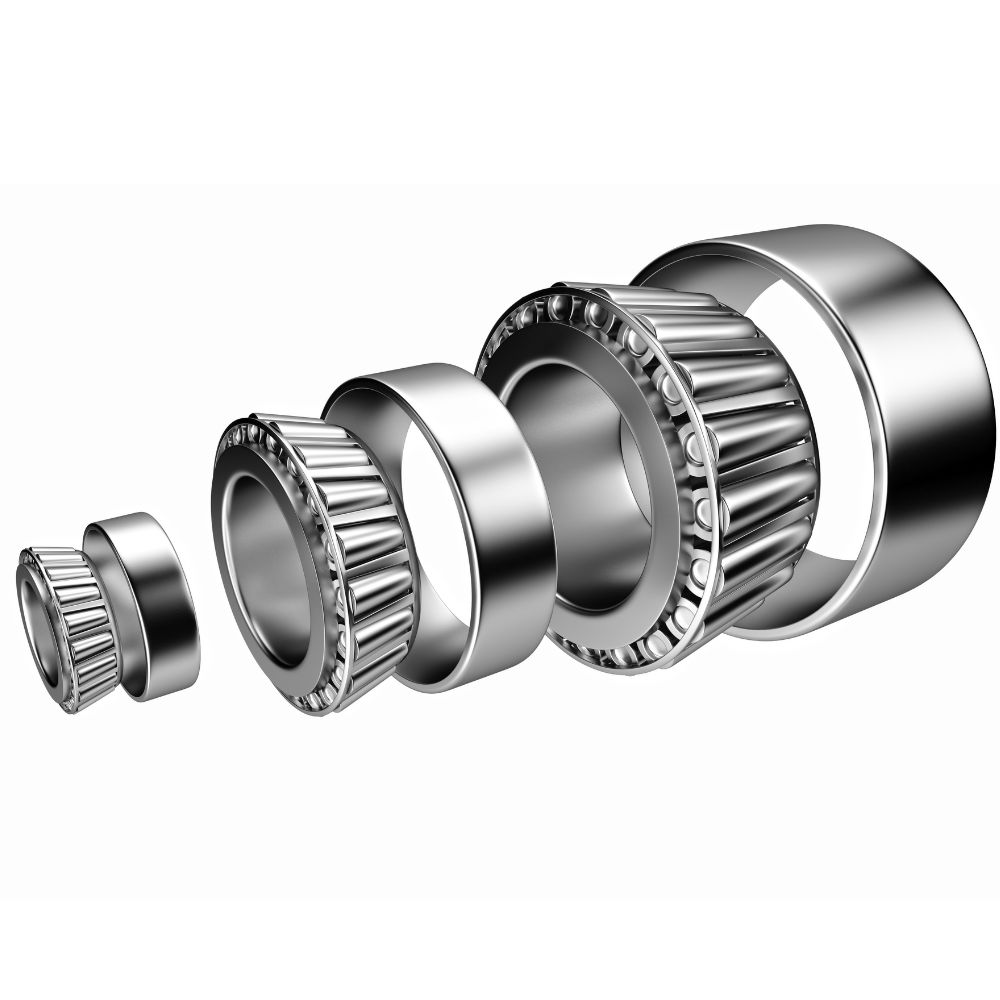
Truck bearing parts support rotating components, reduce friction and help maintain accurate alignment throughout a commercial vehicle. Bearings are used in wheel hubs, transmissions, differentials, drive shafts, engines and other assemblies where one component must rotate relative to another while carrying load.
Bearings are particularly important within the driveline because shafts and gears must remain correctly positioned while transmitting substantial torque.
A truck’s driveline can be simplified as:
transmission → drive shaft → differential → axle shafts → drive wheels.
Bearings support rotating components at several points along this path. Selecting the correct bearing therefore requires an understanding of load direction, dimensions, lubrication, operating speed, fitment and application, not simply whether a replacement appears similar.
What Do Truck Bearings Do?
A bearing allows controlled movement between two components while supporting load and reducing friction.
Without suitable bearings, rotating shafts and wheel assemblies would experience excessive friction, heat, wear and unwanted movement.
A truck bearing can perform several functions:
- support radial or axial loads
- maintain shaft or wheel alignment
- reduce friction between moving surfaces
- allow controlled rotation
- limit unwanted movement
- transfer forces into the surrounding housing
The exact requirement depends on where the bearing is installed.
A wheel bearing, for example, must support vehicle and road loads while allowing the wheel hub to rotate. A transmission bearing must support rotating shafts and maintain gear alignment.
What Are Radial and Axial Bearing Loads?
Bearing selection begins with understanding the direction of load.
A radial load acts perpendicular to the bearing’s rotational axis.
An axial load, sometimes called a thrust load, acts parallel to the axis.
Many commercial-vehicle applications create combined loads, meaning the bearing must manage radial and axial forces simultaneously.
Different bearing designs are therefore used for different mechanical conditions.
This explains why two bearings with similar overall dimensions are not necessarily interchangeable.
What Are the Main Types of Truck Bearings?
Several bearing designs are commonly found in commercial vehicles.
Ball Bearings
Ball bearings use spherical rolling elements between an inner and outer race.
They can operate with relatively low friction and are used in applications requiring smooth rotation at moderate or high speeds.
Deep-groove ball bearings are widely used because they can support radial loads and a degree of axial load in both directions.
Depending on the application, they may be open, shielded or sealed.
Tapered Roller Bearings
Tapered roller bearings use conical rollers and tapered raceways.
Their geometry allows them to support substantial combined radial and axial loads.
For this reason, tapered roller bearings are commonly associated with:
- wheel hubs
- differentials
- pinion shafts
- heavy-duty axle applications
Many tapered bearing arrangements require correct adjustment or preload during installation.
Too much or too little preload can affect bearing temperature, clearance and service life.
Cylindrical Roller Bearings
Cylindrical roller bearings use straight cylindrical rollers.
The larger contact area between rollers and raceways enables them to support significant radial loads.
They are commonly used where high radial load capacity and rotational performance are important, including selected transmission and industrial applications.
Needle Roller Bearings
Needle roller bearings use long, thin cylindrical rollers.
Their small cross-sectional size allows substantial radial load capacity within a compact space.
They can be found in transmissions, universal joints and other assemblies where packaging space is limited.
Where Are Bearings Used in a Truck?
Bearings appear throughout the vehicle, but several applications are particularly important to the driveline.
Wheel Bearings
Wheel bearings connect the rotating wheel hub to the stationary axle or steering assembly. At the same time, the bearing must allow the hub and wheel to rotate freely.
Depending on the vehicle, wheel bearing assemblies may use tapered roller bearings, cartridge-style assemblies or other designs.
Bearing condition can directly influence wheel movement, hub temperature and tyre alignment.
Transmission Bearings
Transmission shafts rotate at different speeds and carry gears that transmit engine torque.
Bearings support these shafts and maintain their alignment within the transmission housing.
Important applications can include:
- input-shaft bearings
- countershaft bearings
- output-shaft bearings
- gear-support bearings
Excessive bearing clearance can alter the relationship between gears and shafts and may contribute to noise or accelerated internal wear.
For more information about the gearbox surrounding these bearings, see our truck transmission parts guide.
Differential Bearings
The differential changes the direction of driveline torque and allows the driven wheels to rotate at different speeds when required.
Several bearings may operate inside the differential.
Pinion bearings support the pinion gear and help maintain its alignment with the ring gear.
Carrier bearings support the differential carrier and ring-gear assembly.
Accurate bearing positioning is particularly important because the relationship between the ring gear and pinion affects gear contact.
Our detailed guide to truck differential parts explains how the differential housing, gears, bearings and axle shafts work together.
Drive Shaft Center Support Bearings
Long-wheelbase trucks may use a two-piece or multi-piece drive shaft.
A center support bearing, sometimes called a carrier bearing in this context, supports the middle section of the drive shaft while allowing it to rotate.
The bearing is commonly mounted within a rubber support that also helps isolate vibration.
Its relationship is:
transmission output → first drive-shaft section → center support bearing → second drive-shaft section → differential.
Read our guide to the role of truck drive shafts for deeper coverage of propeller shafts, universal joints and driveline movement.
Clutch Release Bearings
A clutch release bearing operates within the clutch disengagement mechanism.
When the clutch is operated, the bearing transfers force to the clutch cover or release mechanism while accommodating rotation.
Because it performs a specialised clutch function, detailed coverage belongs within our guide to truck clutch components.
How Does the Truck Driveline Work?
The driveline transfers rotational torque from the transmission toward the driven wheels. Each stage performs a different function.
The drive shaft carries rotational torque over the distance between the transmission and axle.
Universal joints allow torque transmission when the transmission and axle operate at changing angles.
The differential changes torque direction and distributes it toward the axle shafts.
Bearings support the rotating shafts and gears throughout this system.
This makes bearing condition important to driveline alignment, friction, vibration and reliability.
Why Is Bearing Lubrication Important?
Bearings depend on lubrication to reduce friction and separate rolling surfaces.
Depending on the application, lubrication may come from:
- grease
- transmission oil
- differential oil
- engine oil
- factory-sealed lubricant
Lubrication helps reduce:
- friction
- heat
- metal-to-metal contact
- surface wear
- corrosion
However, more lubricant is not automatically better.
The correct lubricant type and quantity should follow the bearing or vehicle manufacturer’s specification. Contaminated, incorrect or insufficient lubrication can shorten bearing life.
Seals are also important because they help retain lubricant while reducing the entry of water and dirt.
What Are Common Signs of Worn Truck Bearings?
Bearing problems can produce different symptoms depending on their location.
Possible warning signs include:
- humming, rumbling or grinding noise
- vibration
- excessive component movement
- abnormal wheel or hub temperature
- uneven tyre wear
- lubricant leakage
- metallic particles in oil
- driveline noise that changes with speed
- looseness in a wheel or shaft
- abnormal transmission or differential noise
These symptoms do not automatically identify one damaged bearing.
A driveline vibration, for example, can also result from drive-shaft imbalance, worn universal joints, incorrect operating angles or damaged mounts.
Correct inspection should therefore come before replacement.
What Causes Truck Bearings to Fail?
Common contributors to premature bearing failure include:
- inadequate lubrication
- contaminated lubricant
- water or dirt entry
- incorrect installation
- excessive preload
- insufficient preload
- misalignment
- overload
- impact damage
- damaged seals
- incorrect bearing specification
- wear in surrounding components
Bearing failure is often a system problem rather than an isolated material failure.
Replacing a damaged bearing without identifying contamination, alignment or lubrication problems can result in repeat failure.
How Do You Choose the Correct Truck Bearing Parts?
Bearing identification should begin with the application and existing reference information.
Before ordering, confirm:
- truck make and model
- manufacturing year
- VIN or chassis number
- bearing application
- axle, transmission or differential model where relevant
- OEM or recognised manufacturer part number
- inside or bore diameter
- outside diameter
- bearing width
- seal or shield configuration
- load and application requirements
Dimensions are useful but should not be the only selection method.
Two bearings can share similar dimensions while having different internal designs, clearances, load ratings or sealing arrangements.
Where available, part-number and application verification should take priority.
For procurement-specific considerations, see our guide to commercial vehicle bearing suppliers.
Why Does Bearing Quality Matter in Commercial Vehicles?
Truck bearings operate under substantial loads and often for long periods.
A bearing that fails prematurely can damage more expensive surrounding parts such as:
- wheel hubs
- shafts
- gears
- differential housings
- transmission components
For fleet operators, the lowest purchase price may not represent the lowest operating cost. Correct specification, dependable manufacturing quality, product traceability and proper installation should all be considered.
Frequently Asked Questions About Truck Bearings and Driveline Parts
What types of bearings are commonly used in trucks?
Commercial trucks can use ball bearings, tapered roller bearings, cylindrical roller bearings and needle roller bearings. The appropriate design depends on load direction, rotational speed, space and application.
Which bearings are used in truck wheel hubs?
Tapered roller bearings are widely used in heavy-duty wheel-hub applications because they can support combined radial and axial loads, although specific hub designs vary by vehicle.
Are drive shaft bearings and differential bearings the same?
No. A drive-shaft center support bearing supports a multi-piece propeller shaft. Differential bearings support components such as the pinion shaft or differential carrier inside the axle assembly.
Can a bad bearing cause driveline vibration?
Yes. Excessive bearing wear or movement can contribute to vibration. However, universal joints, drive-shaft balance, alignment and other driveline components should also be inspected.
Should bearings be replaced based on mileage?
Not all bearings have a universal mileage-based replacement interval. Replacement depends on the vehicle manufacturer’s maintenance requirements, bearing condition, lubrication, load and operating environment.
Build a More Reliable Bearing and Driveline Maintenance Strategy
Truck bearings and driveline components work together to maintain controlled rotation while transmitting power.
Reliable maintenance therefore requires more than replacing a noisy bearing.
Fleet operators and workshops should identify the source of noise or vibration, inspect lubrication and seals, check surrounding components, verify the exact bearing specification and correct the underlying cause of premature wear.
To follow the power-transfer path in more detail, read about truck drive shafts and truck differential parts.
For a broader overview of commercial-vehicle components, visit our truck spare parts guide.
If you need help identifying wheel bearings, transmission bearings, differential bearings or driveline components, contact our sales team with your truck, axle, transmission or existing part details.
Check our ZF Proservice Workshop page.